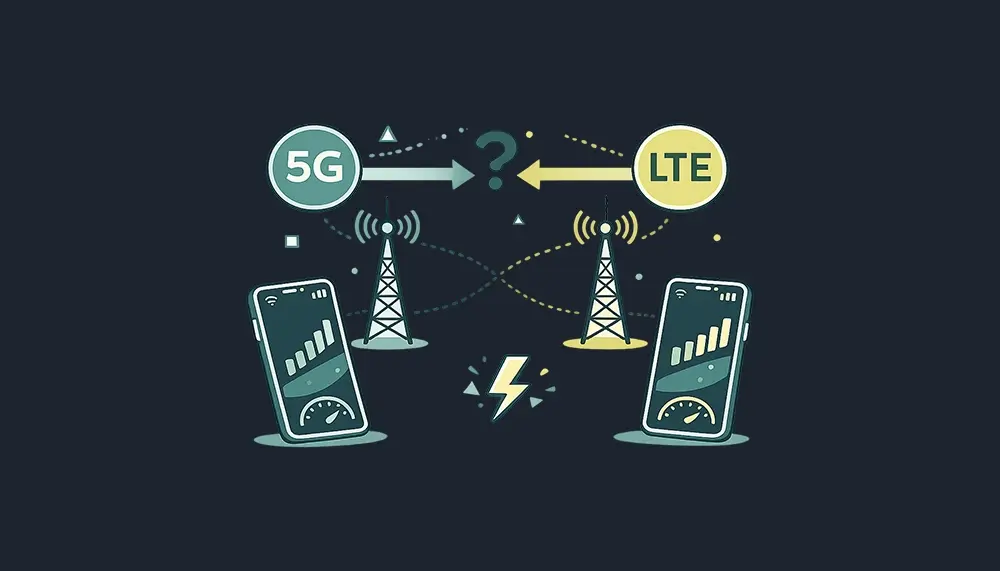
The debate around 5G vs LTE comes down to more than just which icon appears on your phone. The two network technologies are not created equal, and knowing the difference can help you get more out of your phone plan.
Key Takeaways
- LTE (Long Term Evolution) is the fourth-generation (4G) wireless standard that became the backbone of mobile internet across the U.S.; 5G is its faster, lower-latency successor.
- 5G offers real-world download speeds of 150–300 Mbps on mid-band networks, compared to roughly 30–60 Mbps on a typical LTE connection.
- Lower latency is one of 5G’s biggest practical advantages, dropping response times from around 30–50 ms on LTE to as low as 10–20 ms on 5G.
- LTE still provides broad coverage and is reliable for everyday tasks like calls, texts, streaming, and social media.
- 5G’s combination of faster speeds and lower latency opens the door to future technologies like autonomous vehicles, remote surgery, and immersive augmented reality.
The Difference Between 4G LTE and 5G Starts With a Name
LTE stands for Long Term Evolution. It’s a standard under the fourth generation (4G) of cellular networks, and it became the dominant wireless technology in the U.S. and much of the world through the 2010s. Before LTE, mobile internet was noticeably slower and less reliable. LTE changed that, making video calls, music streaming, and mobile navigation genuinely useful for the first time.
5G is the fifth generation of wireless technology. It was engineered from the ground up to do more than just move faster. It’s designed to support far more devices per square kilometer, deliver near-instant response times, and serve as the foundation for technologies that simply weren’t possible on older networks.
Understanding how these two different technologies compare starts with three things: speed, latency, and coverage.
How Download Speeds Actually Compare
Speed is usually the first thing people ask about, and the gap is significant.
On a typical LTE network, median download speeds hover between 30 and 60 Mbps, with advanced LTE networks in strong signal areas pushing closer to 80–100 Mbps.1 That’s more than enough for streaming video, browsing, and downloading apps.
5G changes the scale entirely. On mid-band 5G, the most commonly deployed form in the U.S., median download speeds typically range from 150 to 300 Mbps.1 According to Ookla data, median 5G download speeds in the U.S. exceeded 200 Mbps in early 2024, compared to around 60 Mbps for 4G.2 On millimeter wave (mmWave) 5G in dense urban areas, speeds can reach 800 Mbps to 1.5 Gbps under ideal conditions, though mmWave coverage remains limited.1
For practical everyday use, this means pages load faster, videos buffer less, and large files move in seconds instead of minutes.
Lower Latency: The Upgrade You Feel Before You Measure
Speed gets the headlines, but lower latency may be the more meaningful improvement for most users.
Latency is the delay between sending a request and getting a response. Think of it as the time it takes for your phone to “hear back” from the internet after you tap something.
LTE networks typically deliver latency between 30 and 50 milliseconds.2 On 5G, real-world latency is generally 10–20 ms, with the theoretical floor approaching 1 ms on fully standalone 5G networks.3
That difference shows up clearly during video calls. A 40 ms delay on LTE can create a subtle but noticeable lag. On 5G, conversations feel closer to real-time. The same is true for online games, where lower latency means your actions register faster and gameplay feels more responsive.
For emerging applications like autonomous vehicles and remote surgery, lower latency isn’t a nice-to-have. It’s a safety requirement. A self-driving car traveling at highway speed needs to receive and act on data in milliseconds, not tens of milliseconds.4
Key Differences in Coverage: Where Each Network Shines
Here’s where LTE still holds an advantage: broad coverage.
LTE networks have been deployed and refined for over a decade. They cover rural areas, highways, and remote regions where 5G infrastructure hasn’t yet arrived. If you’re working remotely from a small town or frequently driving through areas without dense cell infrastructure, LTE remains essential.
5G coverage is expanding quickly, especially in metro areas. But not all 5G is the same. There are three distinct bands:
Low-band 5G uses frequencies below 1 GHz. It travels far and penetrates buildings well, making it ideal for rural areas. The tradeoff is that speeds are often similar to advanced LTE.
Mid-band 5G operates between 1 GHz and 6 GHz. This is the sweet spot. It offers meaningfully faster speeds and improved latency over LTE while covering a practical geographic area. Most major carriers have prioritized mid-band deployment.
High-band (mmWave) 5G reaches speeds previously only possible on Wi-Fi or fiber, but the shorter range means it’s mostly found in stadiums, airports, and dense urban blocks.
For most users in most places, mid-band 5G is the version that matters.
4G LTE and 5G as Home Internet Options
One use case where 5G is making a real dent is home internet. Fixed wireless access (FWA) uses a router connected to a cellular network rather than a traditional cable or fiber connection.
5G’s faster data speeds make FWA a practical alternative for households in areas underserved by wired broadband. According to industry data, 76% of customers view 5G fixed wireless connectivity as a compelling broadband option.5 LTE-based home internet exists too, and it works well for light-to-moderate usage, but 5G’s capacity advantage makes it far more suitable for households with multiple connected devices streaming and working at the same time.
LTE vs. 5G for Connected Devices: Capacity Matters
The number of connected devices a network can handle simultaneously is a key difference between the two generations.
A 5G network can support approximately 1 million devices per square kilometer, versus roughly 100,000 for LTE.3 At concerts, sports arenas, or dense urban areas where LTE gets congested, 5G’s larger capacity keeps performance stable even when thousands of people are online at once.
Where LTE Represents Real Value for Everyday Use
Despite 5G’s technical advantages, LTE networks compare favorably for most everyday experience. Email, navigation, video calls, and music streaming all work well on a solid LTE connection.
LTE also tends to use less battery. Early 5G chipsets drew more power, and switching between 5G and LTE signals can drain a phone faster. For users in areas where 5G coverage is still limited, LTE is not a downgrade.
5G’s Role in the Technologies Just Around the Corner
5G was designed with tomorrow in mind. The combination of faster speeds, lower latency, and massive capacity unlocks applications that 4G LTE simply couldn’t support at scale.
Autonomous vehicles need real-time, ultra-reliable communication. A self-driving car that receives data 50 ms late instead of 5 ms late is a much more dangerous car. 5G’s ultra-low latency makes the safety margins achievable.4
Augmented reality and virtual reality demand high bandwidth and low lag to deliver immersive experiences without glitches. 5G makes it possible to run complex AR applications on a mobile device.4
Remote surgery is an area where sub-10 ms latency could let surgeons operate robotics from a different city, with clinical testing already underway.
LTE advanced the mobile internet. 5G is building what comes next.
How to Know Which Network You’re On
Your phone’s status bar shows your connection as “5G,” “LTE,” “4G,” or “LTE-A” (LTE Advanced, a faster variant of standard LTE). The signal depends on your location, your carrier’s network, and whether your device supports 5G.
Most phones sold since 2021 support 5G. Use a compatibility checker to confirm. If you’re in a 5G area but seeing “LTE,” check your phone settings, since some devices default to LTE to conserve battery.
Stay Connected: Choosing the Right Plan for Your Network
Whether you’re on 5G or LTE, what matters most is whether your plan actually delivers on the network you’re using. Vouch Mobile runs on a nationwide 5G network, so you get access to the same towers big carriers customers use. Check your area on the Vouch Coverage Map, and see Vouch’s plans starting at $25/month with 5G included. No contract. No credit check.
Conclusion
LTE transformed how we use our phones. 5G is doing it again, only bigger. For everyday tasks, a solid LTE connection gets the job done well. But 5G’s speed, lower latency, and dramatically higher capacity make it the network that powers what’s coming next, from smarter cities to more immersive experiences to applications that don’t exist yet.
The best version of either network is one you’re actually able to access on a plan that doesn’t limit it. Check your coverage, confirm your device, and make sure your plan is getting you there.
About Vouch Mobile
Vouch Mobile is a modern wireless provider built for people who want premium coverage without the premium price or complexity.
Powered by the same major U.S. networks as the big carriers, Vouch delivers simple, transparent plans with no hidden fees, no contracts, and a seamless digital experience that lets you switch in minutes and keep your phone and number.
Whether you’re looking to save money or just want a more straightforward way to stay connected, Vouch Mobile makes wireless make sense again. Ready to get started? Pick Your Plan: https://vouchmobile.com/
Frequently Asked Questions
Is 5G really that much faster than LTE?
Yes, in most cases. Real-world 5G mid-band speeds are typically 3 to 5 times faster than average LTE. The improvement is most noticeable for large downloads, streaming, and use in crowded areas where LTE gets congested.
Can I still use LTE if 5G isn’t available in my area?
Absolutely. LTE remains available across nearly all of the U.S. and handles everyday use, including calls, texts, navigation, and video streaming, without any issues.
What does LTE-A mean compared to regular LTE?
LTE-A stands for LTE Advanced. It’s an upgraded version of the LTE standard with faster peak speeds and improved capacity. It sits between standard LTE and 5G in terms of performance.
Do I need a new phone to use 5G?
Yes, 5G requires a 5G-capable device. Most smartphones released in 2021 or later support 5G. You can use a compatibility checker to confirm whether your current phone supports it before switching plans.
References
-
- https://www.robustel.store/blogs/industrial-iot-blog/lte-vs-5g-speeds-performance-real-world-benchmarks-vs-theoretical-limits
- https://www.earthlink.net/blog/whats-the-difference-between-4g-lte-and-5g-mobile-networks/
- https://www.uctel.co.uk/blog/5g-vs-lte-speed-coverage-signal-strength-comparison
- https://www.taoglas.com/blogs/4g-vs-lte-vs-5g-key-differences-in-network-capabilities-and-performance/
- https://scoop.market.us/5g-statistics/